Priscilla Hennekam
Released 17 Jun, 2025
For decades, the wine industry has relied on a simple belief: educate the consumer, and they’ll come around. But the world has changed. Modern consumers aren’t looking for lessons. They’re looking to be understood.
In an era shaped by AI, intention-driven algorithms, and collapsing institutional trust, the old playbook no longer applies. We produce, then promote. We build rituals, then try to explain their meaning. We launch wines, then search for a market.
If we want to stay relevant, we need to flip the script.
This is not just about marketing. It’s about cultural shift. It’s about shifting from control to connection. From education to empathy. From broadcast to belonging.
Back in 2015, Marty Neumeier wrote ‘The Brand Flip: Why customers now run companies and how to profit from it’. Interviewed about the book later, he said
“Convincing isn’t really possible in an age of customer control. Customers hold most of the cards today. They have good visibility into their choices, and they can easily share information with each other. Not only that, they don’t like to be sold. But they do like to buy. Your job shouldn’t be to convince customers to buy, but to help them buy what they want. How do you offer what they want? By thinking first about the customer instead of the company, and more about the relationship than the transaction. This is the essence of today’s branding” - Marty Neumeier
[center]
[/center]
The Rethinking Wine Platform Is Live
Beta-testing has started. The first 20 members are already inside, testing, shaping, and giving feedback. But we had to hit pause. With community members across 80+ countries, we faced technical and legal challenges we hadn’t fully appreciated in advance. Building a global, democratic community isn’t simple, but we’re doing it anyway. Problem by problem, together.
Why This Matters?
-
Connection That Drives Progress: The wine world is fragmented, by geography, tradition, ego. We’re bringing people together across roles, regions, and backgrounds. Because when everyone’s at the table, everyone gets smarter.
-
Faster Learning, Smarter Decisions: In a world that’s changing fast, slow knowledge is a liability. We don’t wait for the next conference or white paper. We learn from each other in real time, and move.
-
New Knowledge, Not Just More Noise: Most education repeats the same lessons. We surface new insights from people on the edges, where innovation always begins.
-
Trust in a Noisy World: We’re not building for attention. We’re building for trust. This is a space for honest dialogue, shared values, and collaboration. Not algorithms. Not posturing. This is open, made by the community, for the community.
We’re still building. And we need people like you - curious, creative, collaborative - to help shape what comes next.
If you want to join us, or help us face the next challenge, add your email to the waitlist - Click here
Let’s #rethink, together.
Stop Making Keys. Start Understanding the Door.
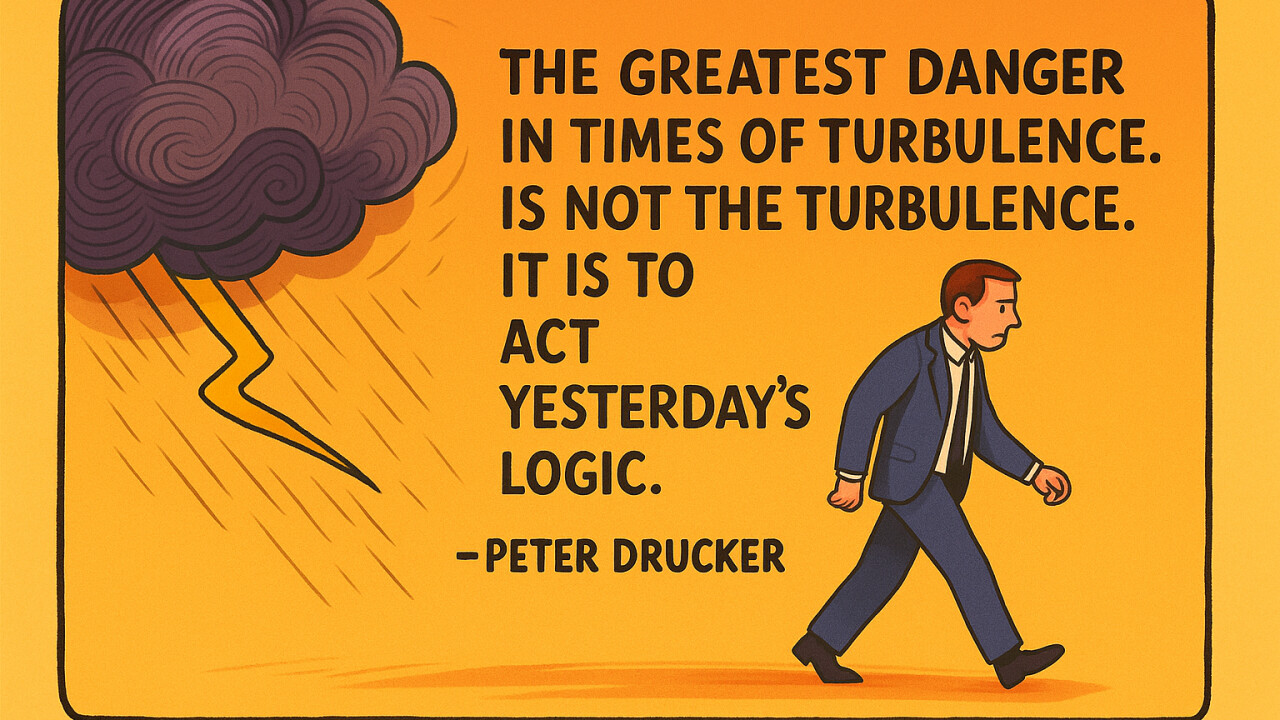
Times are changing. But we’re standing still. Peter Drucker famously warned:
“The greatest danger in times of turbulence is not the turbulence. It is to act with yesterday’s logic.” - Peter Drucker
For too long, the wine industry has followed a backwards logic: make the wine, then find the market. Train sommeliers, then try to find the audience. Build rituals, then hope they resonate.
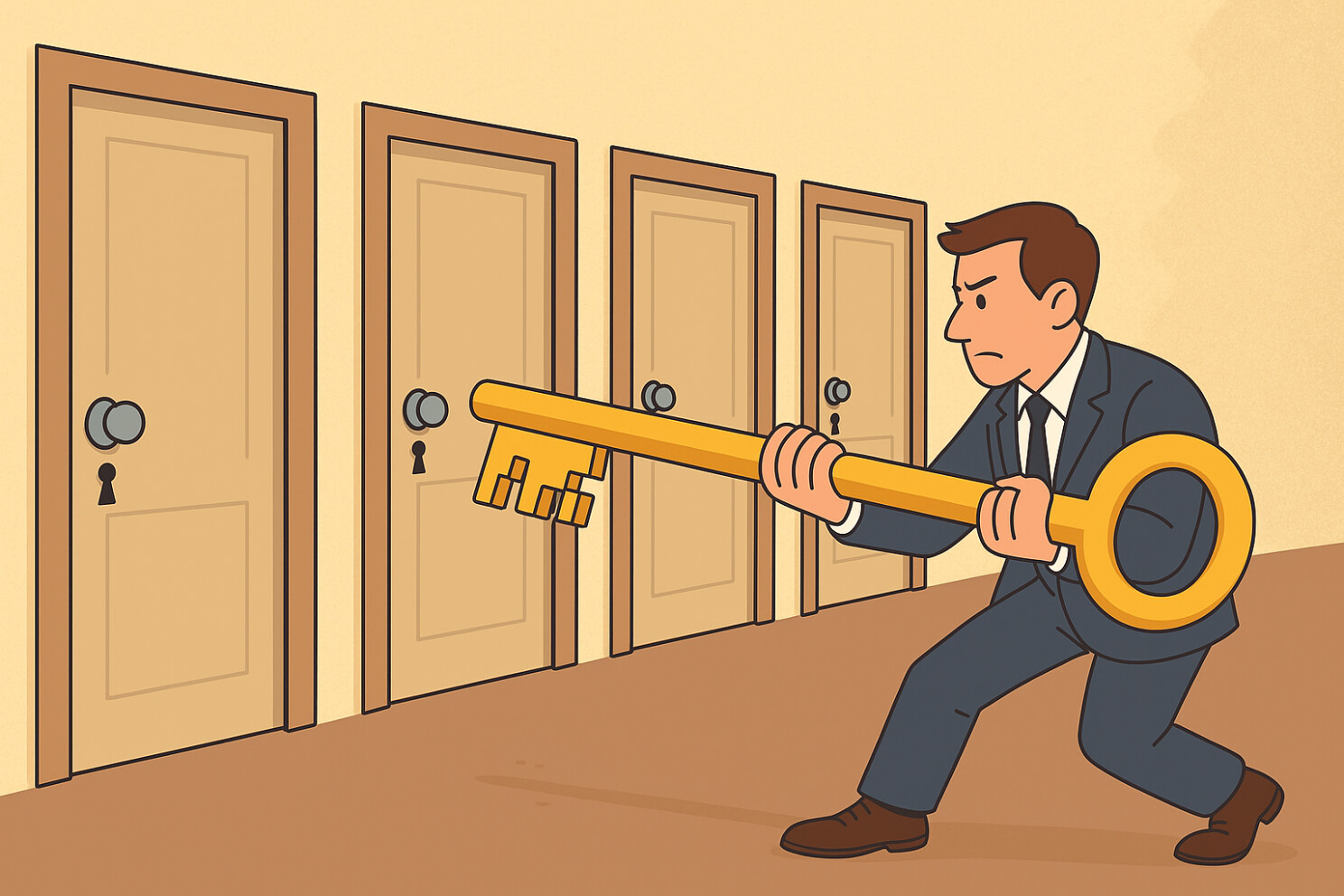
Seth Godin famously said in his book ‘This is Marketing: You Can’t Be Seen Until You Learn To See’, that it’s easier to make a key for a specific lock than to build a key and wander around trying to find which lock it fits.
Yet that’s exactly what we keep doing.
We produce more styles. Launch more labels. Create more complexity. Always hoping to reach more people, but never stopping to ask: Who are we really trying to reach?
Rethinking Wine in the Intention Economy
We’re entering a new kind of economy, one driven not by attention, but by intention. In this emerging landscape, companies no longer wait for consumers to choose. They predict what we might want. AI systems anticipate our next move, serve content before we ask, and influence decisions before we even realise they need to be made. (See: Beware the Intention Economy)
In today’s intention economy, artificial intelligence and predictive algorithms don’t just respond, they shape demand. They turn behaviour into foresight, and foresight into persuasion. This shift has redefined expectations. Consumers now assume that brands will understand them, anticipate them, and reflect their values without needing to be told.
In this new reality, we can no longer rely on educating consumers about our product. Because they’re not expecting to be educated, they’re expecting to be seen. Understood. Anticipated.
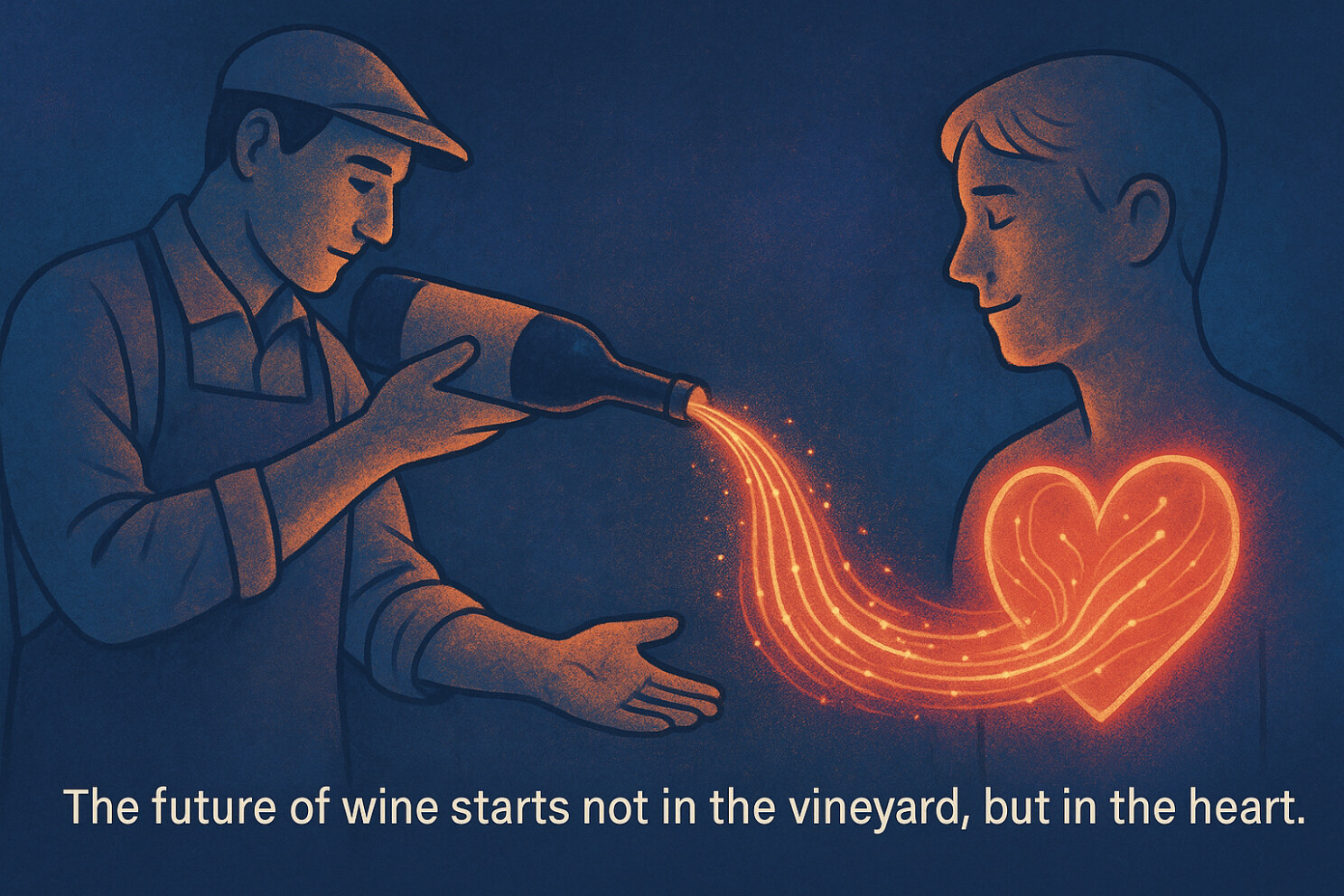
The brands that thrive today, they’re the ones that listen first, design with empathy, and connect on a deeply human level. The future of wine must begin not in the vineyard or the cellar, but in the heart and mind of the consumer.
This doesn’t mean sacrificing craftsmanship. It means aiming it.
Aim it at connection. At relevance. At meaning. At moments people actually want to be part of. That’s how you unlock something deeper than loyalty. You unlock belonging.
A New Generation, A New Logic
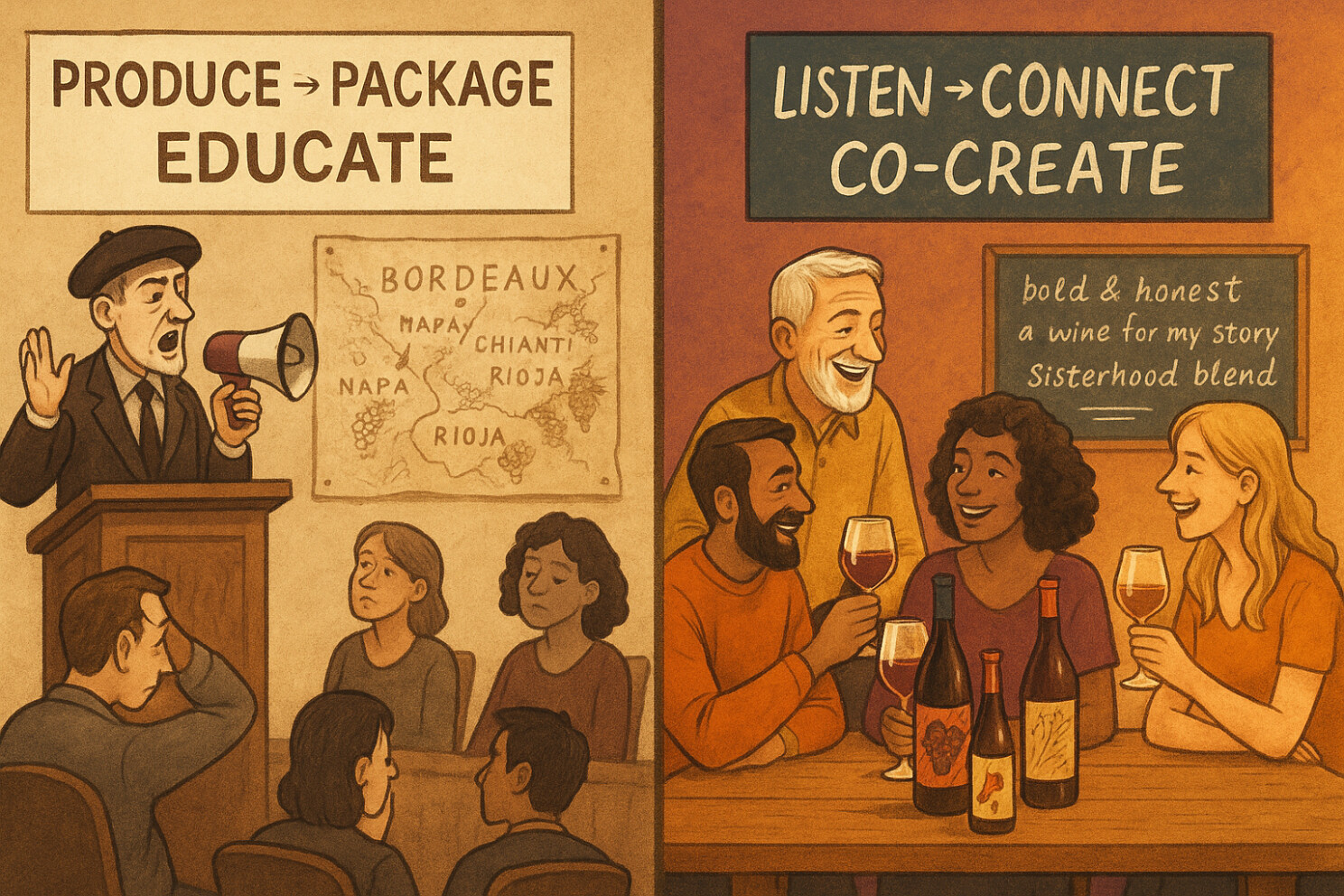
For decades, the wine industry followed a linear, top-down approach:
PRODUCE → PACKAGE → EDUCATE
This model worked, for a time. But the terrain has shifted. And many of us are still using yesterday’s maps. We created the wine. We crafted the labels and narratives. Then we spent time and money educating consumers on how to “get it”.
But today, that model is showing its age.
-
Consumers no longer want to be educated - they want to be engaged.
-
They’re not looking to pass a test - they’re looking for something that fits into their life.
-
The problem isn’t lack of knowledge. It’s lack of emotional resonance.
And if we’re honest, even many professionals don’t “get” the system anymore. Appellations, classifications, certifications - they no longer inspire trust. They confuse more than they clarify.
We are selling knowledge when what people want is connection.
They’re not climbing the same ladders we did. They’re not seeking approval from gatekeepers. They’re not looking for “correctness”.
It’s time to flip the model:
LISTEN → CONNECT → CO-CREATE
Let’s break it down:
-
Listen: Stop assuming we know what the market wants. Start paying attention to what people are actually craving, not just in flavour, but in identity, community, and experience.
-
Connect: Instead of broadcasting information, open emotional pathways. Use language that resonates. Stories that include. Experiences that move.
-
Co-create: Invite participation. Let people shape the meaning with us. The future belongs to the brands that build with, not just sell to.
This model doesn’t mean dumbing wine down. It means re-humanising it.
The new generation aren’t rejecting wine. They’re rejecting how we talk about it. They’re not asking us to teach them. They’re asking us to understand them. Modern consumers are asking different questions. They’re not looking for hierarchy. They’re looking for authenticity. They’re not impressed by prestige. They’re moved by connection. And they don’t trust institutions the way we once did, they trust communities.
This flips the entire paradigm.
Instead of dictating meaning, we co-author it. Instead of broadcasting, we invite. Instead of guarding prestige, we build community.
And that changes everything, from how we build brands to how we design experiences to how we measure success.
In this new landscape:
-
Emotional resonance beats formal recognition
-
Decentralised communities shape influence and connect people
-
Loyalty is earned through shared values, not technical explanations
So what does that mean for the wine industry?
It means the future won’t be shaped by what we keep. It will be shaped by what we’re brave enough to let go of.
We need to stop acting with yesterday’s logic, and start building what tomorrow actually needs. The old logic told us that expertise was everything. The new reality shows us that empathy is more powerful.
Connection Is No Longer a Tactic, It Is the Product
This is where many in the industry get it wrong.
They still treat emotional connection like an extra. A marketing tool. A layer we add on top of the “real” value - which they still believe is terroir, tradition, technique.
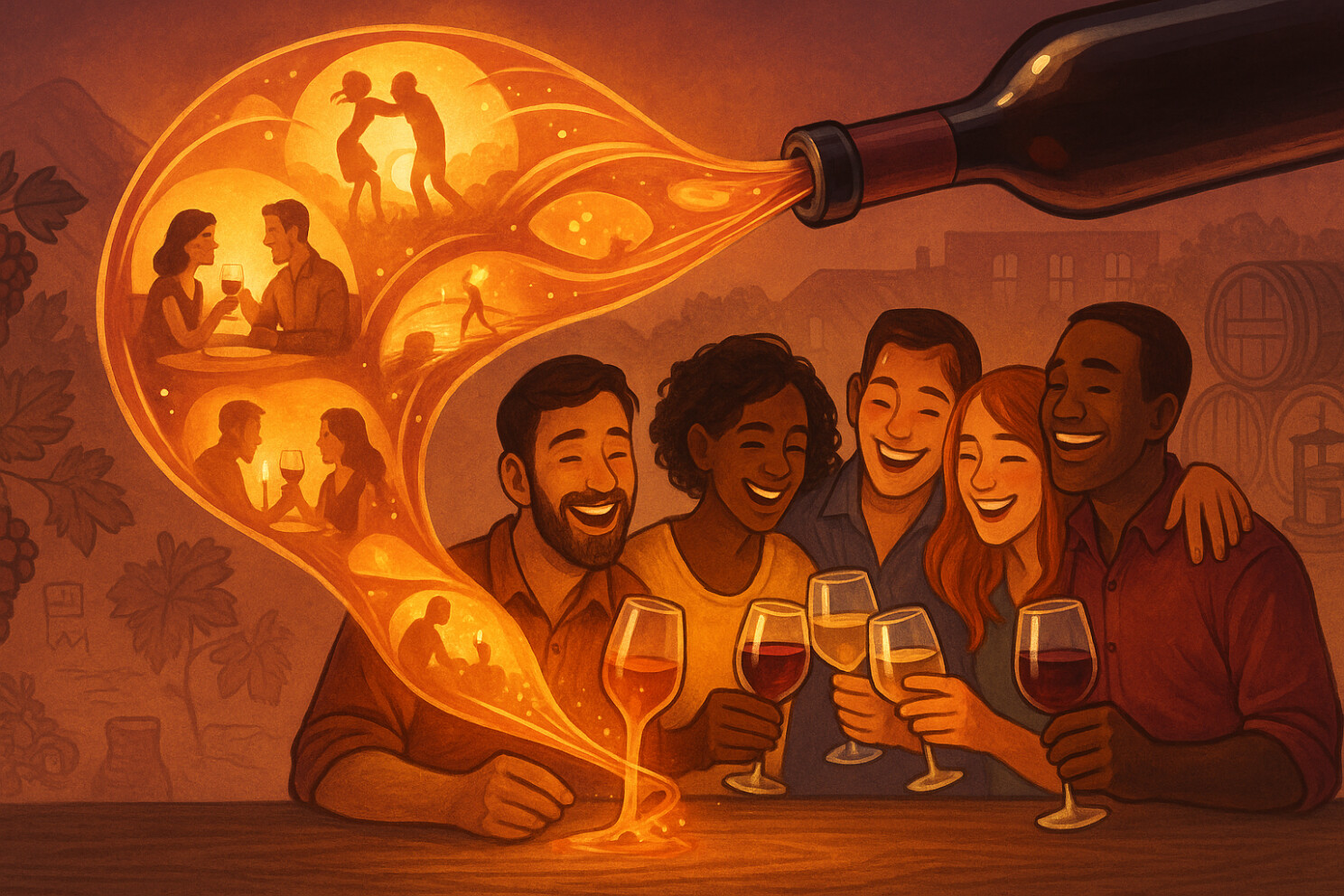
But the truth is: emotional connection IS the value.
It’s what turns a bottle into a story. A product into a memory. A customer into an advocate. And if we don’t make people feel something, we lose them.
Today, connection isn’t a means to an end. It is the end.
The Collapse of Institutional Trust, and the Rise of Community
We’re also seeing a deeper societal shift that impacts us far beyond wine. People no longer place blind trust in institutions. Not in media. Not in politics. Not even in science.
And definitely not in wine authorities.
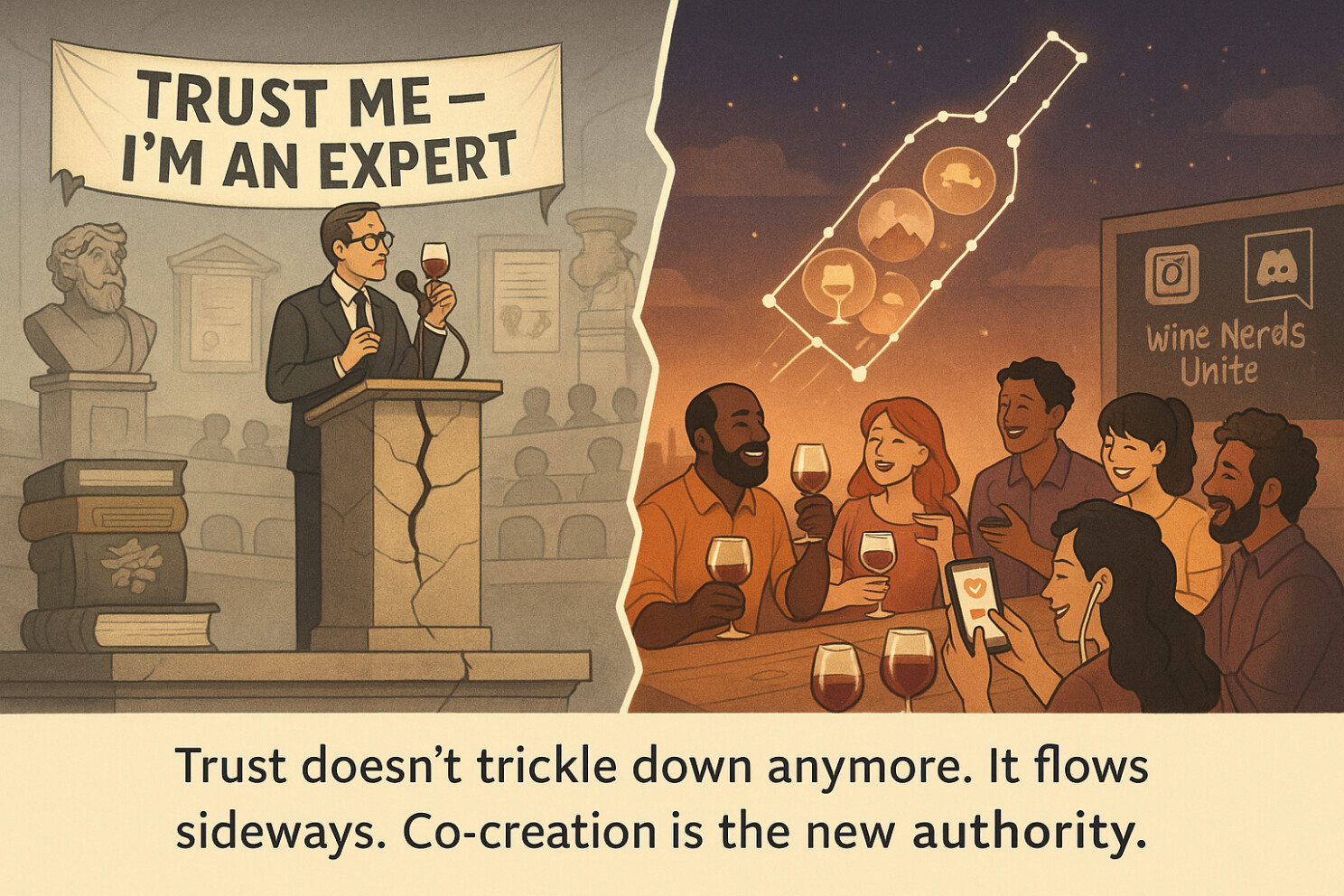
Trust has moved, from vertical institutions to horizontal communities. In this new world, influence doesn’t trickle down. It spreads sideways.
-
It’s the Instagram account that tells people where to go, not the critic.
-
It’s the WhatsApp group or Discord server that shapes opinions, not the sommelier.
-
It’s peers who build credibility, not professionals.
So if your strategy is built on being the “expert at the front of the room”, it’s already outdated.
In this environment, co-creation is the only authority that matters.
Proof It Works - Brands That Started with Community
This isn’t just an abstract idea. Some of the most successful and culturally relevant brands today didn’t start with a polished product or a perfect story. They started with a community.
Here are a few that prove the power of connection-first thinking:
-- Glossier (Beauty) –
Glossier didn’t begin as a cosmetics company. It began as a blog - Into the Gloss - where founder Emily Weiss interviewed real people about their beauty routines.
The community came first. The product came after. And because the audience already felt heard, the brand’s first product drop turned them into co-owners, not just customers.
Glossier grew into a billion-dollar company, not because of product innovation, but because of emotional resonance and community trust.
– Liquid Death (Water) –
A can of water that looks like a beer? On paper, it sounds ridiculous.
But Liquid Death understood something deeper: That people, especially younger consumers, don’t buy products. They buy attitude. They buy belonging**.**
The brand built its identity around irreverence, community humour, and a rejection of wellness elitism. Its merchandise sells out. Its fans feel like part of a movement - hundreds of people have even got a tattoo of their logo! And it’s now valued at $1.4 billion… selling water.
– Bobbie (Infant Formula) –
Bobbie disrupted one of the most regulated and emotionally charged industries - baby formula - by starting where others didn’t: with the parents.
Instead of leading with lab specs, Bobbie led with trust and transparency. It listened to real concerns from mothers and built a brand that felt human, honest, and aligned with modern values - clean ingredients, European standards, and non-toxic packaging.
But more importantly, it built a community of parents who felt seen and respected - not judged.
From social listening to co-creating with mothers, Bobbie flipped the traditional formula playbook. It didn’t say “We know best”. It said: “We’ve been where you are”.
The result? Rapid growth, incredible loyalty, and a brand that stands for more than just nutrition - it stands for empowerment and empathy in a space long dominated by sterile, corporate giants.
Why This Matters for Wine
Too many wine brands still start with the product, and proudly say, “We make the wines we like to drink”.
That’s fine if you’re making wine for yourself, but if you need to sell, you need to remember most of wine consumers aren’t like you. They are not you. And that’s where so many in our industry get it wrong.
That doesn’t mean your palate is irrelevant. It means your perspective is limited. Because the real question isn’t “Do I love this?” It’s “Does it move them?”
And here’s what the best brands I have seen, have figured out:
They’re not starting with what they want to say. They’re starting with who they want to serve. They’re building with the community, not just for it. They’re making people feel seen, heard, and welcomed - from Day One.
And in return?
They’re earning something far more valuable than a shelf placement or a Parker score. They’re earning loyalty, advocacy, and cultural relevance - not just one-off sales.
Why We Must Let Go, Even When It Feels Risky
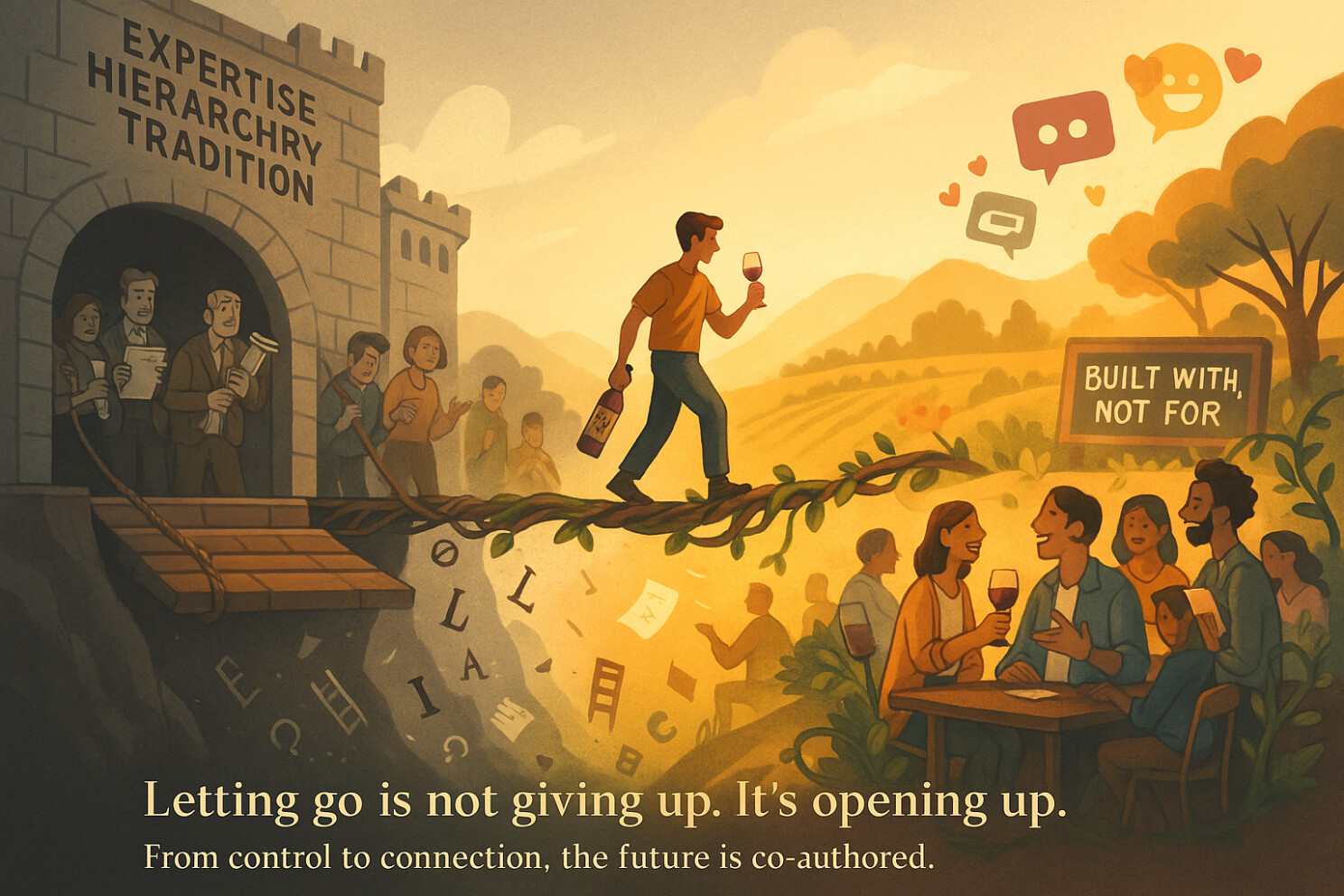
Letting go of old systems feels uncomfortable. There’s prestige in expertise. There’s safety in structure. There’s history in hierarchy.
But if we hold on too tightly, we’ll miss what’s coming next.
The most forward-thinking brands and professionals today aren’t defending their turf. They’re building new spaces for participation.
They’re:
-
Creating content people actually want to share
-
Designing experiences around feelings, not facts
-
Making wine part of broader cultural conversations
-
Engaging with audiences not just as drinkers, but as contributors
This is what it means to move from control to connection. From defensiveness to dialogue. From legacy thinking to adaptive leadership.
So What Does This Mean for You?
If you’re a winemaker, marketer, educator, manager, CEO or entrepreneur, this shift isn’t theoretical. It’s strategic. And it’s urgent.
You don’t need to abandon what you know. But you do need to ask:
-
Are we listening deeply enough to what people actually seek?
-
Are we making space for connection, or just delivering information?
-
Are we inviting co-creation, or trying to stay in control?
And maybe most importantly:
If we want to build a future-proof wine industry, we need to stop trying to teach everyone to become us, and start becoming more open to who they are. In today’s world, identity is one of the most powerful sources of value.
Because in the end, the entrepreneurs, wine professionals, and communities that thrive won’t be the ones that know the most. They’ll be the ones that connect the best.
Are we acting with yesterday’s logic… or building the future we say we want?
So, What’s Next?
We’re entering an era where:
-
Community outperforms campaigns
-
Trust is built through dialogue, not doctrine
-
Loyalty comes from shared values, not just quality metrics
-
The story isn’t what we say, it’s what people feel
The good news? There’s a growing wave of wine professionals ready to lead this shift. People who aren’t clinging to control, but leaning into co-creation. People who understand that the next generation isn’t disengaged, they’re just waiting for a story that feels like theirs.
Thank you Rethinking the Wine Industry community. Let’s write our story, together. 
Be part of the change: Rethinking Wine