Jon Stamell
Released 9 Dec, 2025
I went to a seltzer event last Friday, and it was wall-to-wall Gen Z. Honestly, it was one of the best places I’ve been in a long time to observe people outside my usual age circle and friendship bubble. Not in a judgmental way, but in a curious, almost anthropological way. How they connect with each other. How they talk about identity. How they navigate social spaces. What they choose to drink, and what they actively avoid.
And that’s where it got really interesting.
Seltzer has become a thing, and wine, at least in spaces like this, hasn’t. So I did what I always do when I’m trying to understand a shift, I started talking to them. Making friends. Asking questions. Listening properly. I asked a few of them if they liked wine, and the answers were almost identical.
“Wine is too intimidating.” “Too many grapes.” “It feels like you need to study before choosing a bottle.” “I don’t want to feel stupid ordering it.”
That word kept coming up - intimidating. This is a belonging issue. It’s a confidence issue. It’s a cultural gap we keep pretending doesn’t exist.
Because I don’t think we’re really listening to them.
They don’t care about what previous generations cared about, the hierarchy, the rules, the rituals, the unspoken expectations. But we keep serving them the same old script and acting surprised when they don’t buy tickets to the show. We keep protecting the complexity that makes us feel proud, even when that same complexity makes them feel excluded.
And I get it.
Change can feel like letting go of your own son. Especially when the people who built the industry, the ones who worked relentlessly to create what wine became, are the same people now being asked to question it. That’s not easy. There’s pride there. Identity there. History there. But if we don’t evolve the way we communicate, the way we welcome people in, and the way we make them feel safe to explore without needing a degree before their first sip, we’re not preserving wine’s future. We’re preserving our comfort.
So my question for us is:
When was the last time you stepped outside your comfort zone and went to an event where nobody looked like you, drank like you, or spoke your language of culture? When was the last time you let yourself be the outsider for a night - just long enough to see how the world feels from the other side of the table?
Because sometimes the biggest insights about wine won’t come from another tasting. They’ll come from paying attention to what people are choosing instead, and asking why.
That’s why I wanted to bring someone who lives in the world of data, segmentation and customer language every day, but who has also spent years working with wine and other consumer categories to talk about this topic.
This piece is written by Jon Stamell, CEO of Oomiji Inc. in New York. Jon and his team analysed more than 100 data sets, projections, research reports and articles on wine, using AI and 90+ years of combined wine and consumer marketing experience to pinpoint the industry’s biggest opportunities and blind spots.
In the article that follows, he shows why wine is “speaking Greek to a generation fluent in emojis” and how tools like NPS, CLV, feedback loops and community - already standard in beauty, skincare and tech - could help us rebuild trust and relevance in wine.
[center]
[/center]
Rethinking Wine is a space for connection, collaboration and change. We’re building a global culture and community where people help each other, share knowledge, and create win-win outcomes that move the industry forward.
Only people on our mailing list will be part of the launch, not because this is about exclusivity, but because this is about protecting the culture from Day One.
Join us at rethinkingwine.app
By: Jon Stamell, CEO, Oomiji Inc. , New York
Almost daily, we read that the American wine industry has reached an inflection point—and it’s not a gentle slope. Every year, 2.6 million Boomers—the generation that made wine their preferred drink—are aging out of the category.
The generation that built Napa tasting rooms, kept Bordeaux on allocation lists, and treated Parker scores like gospel is literally leaving the table. Their departure is triggering what one analyst calls “the generational cliff.”
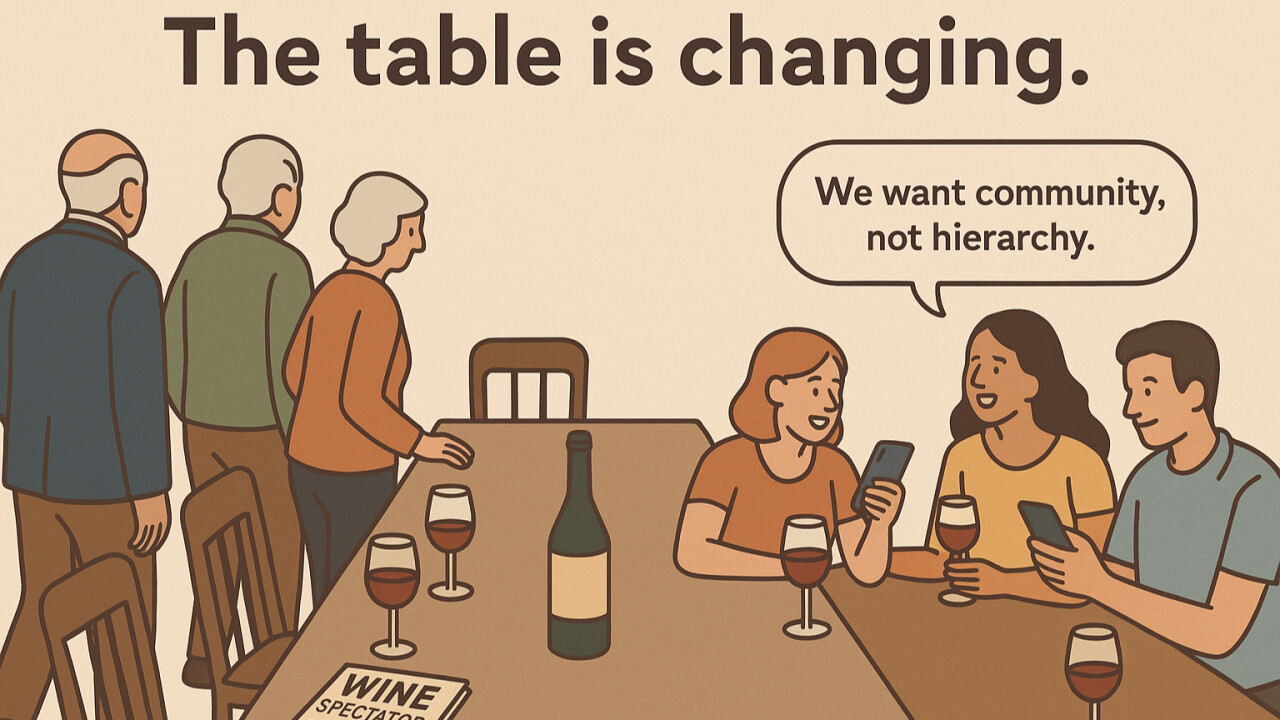
Younger consumers—especially women, Millennials, and Gen Z—are drinking differently, thinking differently, and connecting to brands through values and identity, not hierarchy. If wine wants to stay relevant in the next decade, it has to stop talking to itself and start listening to its customers. That means borrowing a page from industries that have already cracked the code: beauty, skincare, and tech—where community, testing, personalization, and belonging drive loyalty.
We recently reviewed more than one-hundred data-sets, projections, research reports and articles about wine to see what the industry and pundits who follow it are missing. Where might there be opportunities that have been overlooked? Yes, we used AI to help, because the task of finding common streams of thought and gaps where opportunities can be found is too big for any one person. Once we got the AI report, we used our team’s 90+ years of wine and consumer product marketing experience to formulate strategies and tactics that wine marketers have been overlooking. It’s time for that to change.
The Demographic Earthquake
Boomers still spend the most on wine today, but their numbers are shrinking fast. Gen X, the logical bridge generation, isn’t filling the gap—they drink less wine and more beer. Millennials, especially those in their 30s and early 40s, represent the largest adult population segment and have significant disposable income, yet underperform in wine preference compared to spirits and beer. Meanwhile, Gen Z—once tagged as “sober curious”—is showing new signs of life in alcohol consumption. Between 2023 and 2025, Gen Z’s participation in alcohol rose from 46% to 70%, but wine accounts for less than 2% of their club memberships
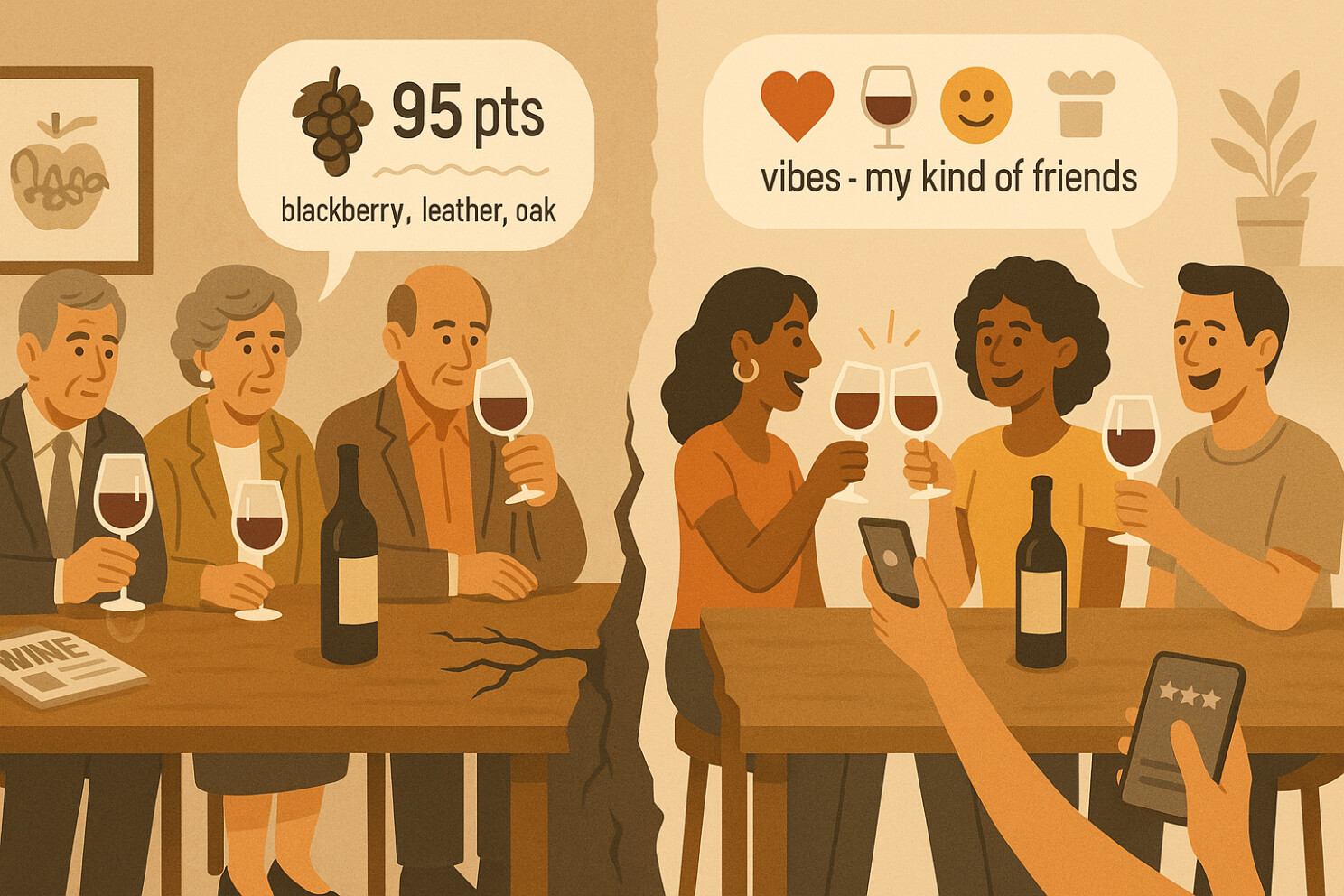
Overlay gender and the story takes shape. Women now represent 57% of wine consumers and make 80% of wine purchases. Yet much of wine marketing still assumes a male wine collector model—hierarchical, ratings-driven, and prestige-oriented. The problem? That’s not how women buy, share, or experience wine. Women build communities, not collections. They engage through conversation, social media, and shared experiences. They want authenticity, wellness, and inclusion—not lectures about terroir. The traditional 100-point rating system still resonates with 62% of Boomers but only 28% of Gen Z. Nearly half of younger drinkers rely more on peer reviews and influencer recommendations than critics.
The data tells a simple story: wine is speaking Greek to a generation fluent in emojis.
From “Brand Loyalty” to Lifetime Value
Most wineries talk about loyalty, but few measure it in meaningful ways. They may track email open rates, club renewals, or event attendance, but those metrics only show behavior, not sentiment. What’s missing is the connection between how customers feel, why they act, and what that means for lifetime value.
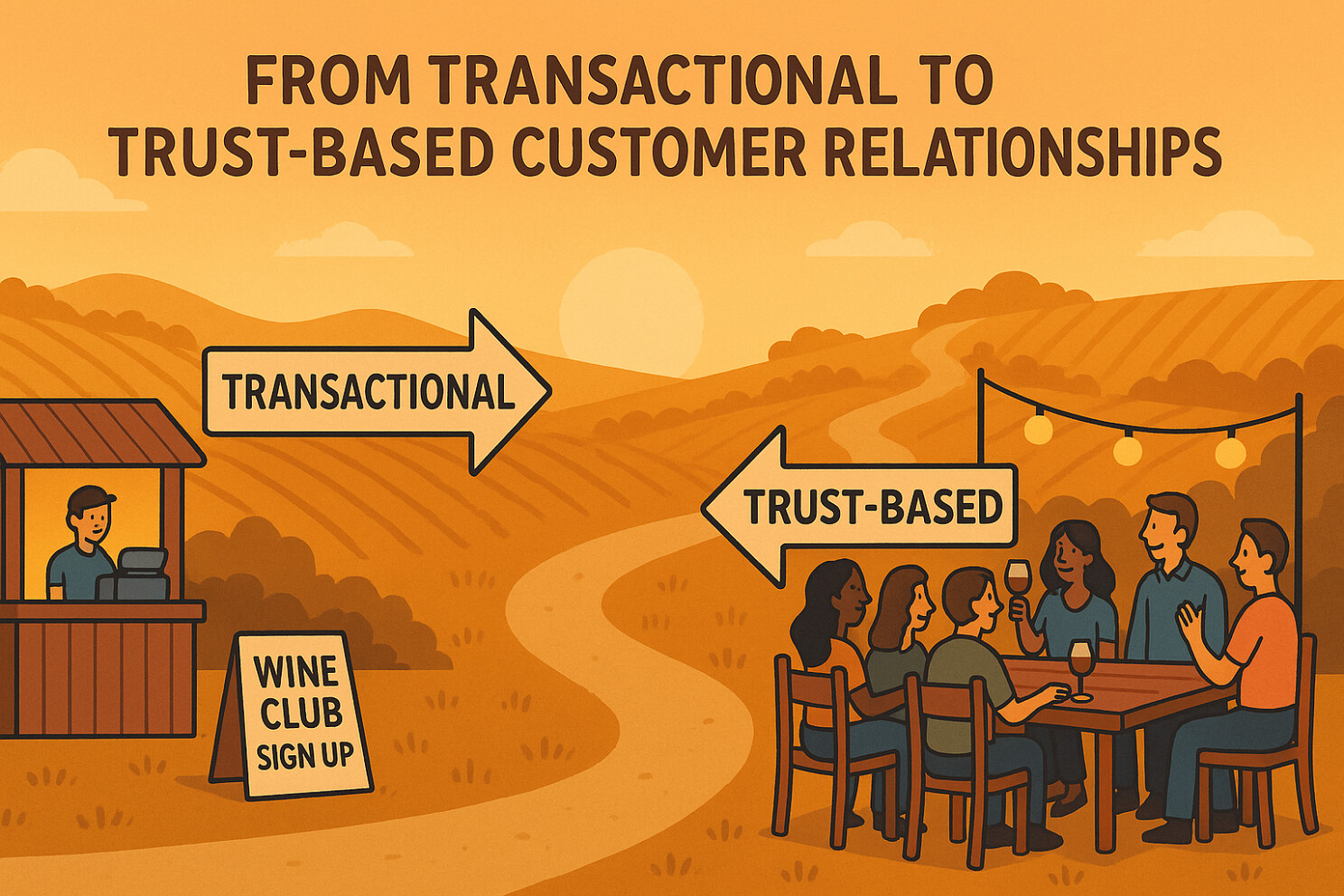
In business terms, that’s the difference between vanity metrics and customer intelligence. It’s the difference between relying on past behavior versus what consumers want now. Two tools—Net Promoter Score (NPS) and Customer Lifetime Value (CLV)—have transformed industries from airlines to SaaS, but they’ve barely touched wine. NPS asks a simple question: Would you recommend this brand to a friend? And Why? CLV measures how much that relationship is worth over time. Together, they form a roadmap for understanding not just who buys, but who belongs.
The beauty of this approach is that it moves the conversation from transactions to trust. If you know which customers are promoters and what they’re saying, you can segment and personalize. If you know who’s on the fence, you can move them to your side. The point is not to collect another dashboard number—it’s to build relationships that last a lifetime.
What Beauty and Skincare Already Know
I walked into a Sephora store one day and thought I was in a wine store. There was overwhelming choice, confusing jargon, foreign and natural ingredients, government regulation and an intimidating expert culture. Beauty brands once face similar barriers as wine, but instead of doubling down on prestige, they democratize it. They make sampling part of the experience. They create digital tools to personalize products. They build communities where authenticity, not perfection, wins.
The results speak for themselves: while wine volumes have declined, beauty and skincare are growing at double digits. Their secret? Constant feedback loops. Every quiz, subscription box, and influencer review feeds a learning system that connects product discovery to emotional payoff.
Consider what happens when a consumer walks into Ulta or Sephora. They’re greeted by interactive screens, sampling bars, and consultants who start with experience, not education. Beauty figured out that the surest way to make complex products accessible is to make them fun. Wine, by contrast, still opens the textbook first.
The parallels are striking: both industries rely on sensory experience, natural ingredients, and deep emotional connection. But beauty transformed complexity into play, while wine turned it into pressure.
Lessons Wine Can Steal
Our consumer analysis outlines how wine could adapt beauty’s playbook—and none of it requires losing authenticity:
-
Sampling without stigma: Launch discovery kits and 375ml formats that let consumers explore without a $50 gamble. Think “subscription discovery,” not “wine club.”
-
Nano-influencer programs: Replace polished brand ambassadors with authentic creators who have 1,000–5,000 followers. Beauty’s “skinfluencers” outperform big names 2–3x in engagement because they’re trusted, not famous.
-
Experience before education: Host casual, sensory-first events—pop-up tastings, music pairings, picnic flights—where curiosity leads to knowledge, not the other way around.
-
Digital diagnostics: Just as skincare brands offer quizzes to match skin types, wineries could use palate-profile quizzes and AI recommendations to connect flavor to personality.
-
Values alignment: Build communities around sustainability, wellness, and transparency. 71% of Gen Z say they’ll pay more for sustainable or ethical products—and 62% research producer practices before buying.
This isn’t about chasing trends. It’s about redesigning trust. If you want more transactions, build relationships first.
Listening as a Growth Strategy
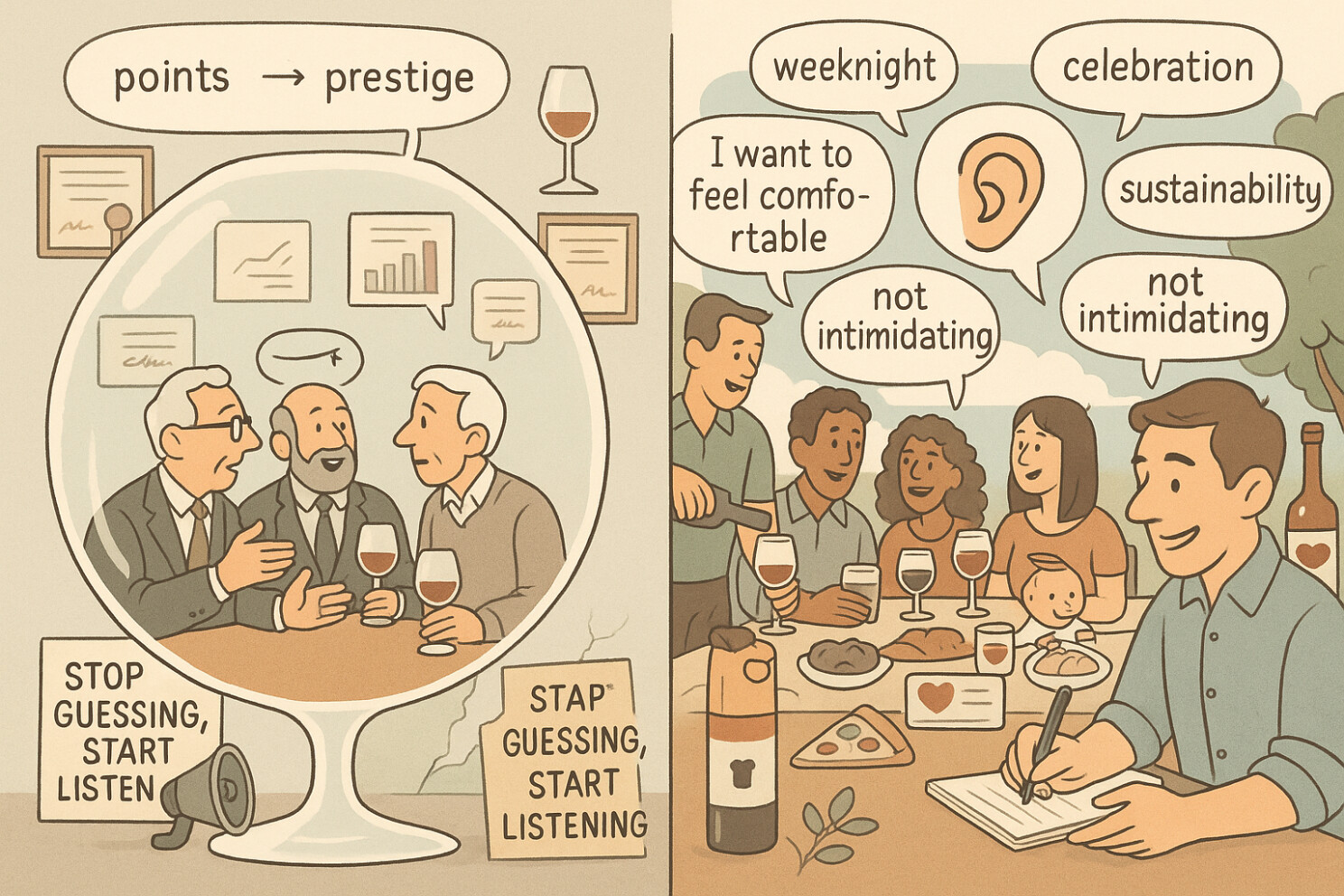
Many wineries are doing some of the tactical executions above but they should come from listening to what consumers want, not what wineries think they want. Wine’s next era will belong to the brands that listen best. That means evolving from the myth of “educating the consumer” to the reality of learning from them. The data is clear: 62% of casual wine drinkers cite intimidation as their top barrier to deeper engagement. They don’t want to be lectured; they want to belong.
By capturing and analyzing the language of real customers—what they say in surveys, social media, or club feedback—wine brands can move from assumptions to empathy. The payoff isn’t abstract. In beauty, similar data-driven personalization efforts increased retention by 30% and lifetime value by 40%. For wineries, those same metrics could be the difference between surviving the Boomer exit and becoming part of its obituary.
From Echo Chamber to Community
For decades, the wine world has operated inside an echo chamber—talking to itself about craftsmanship, tradition, and legacy while younger consumers talk about wellness, sustainability, and experience. Those values aren’t incompatible, but the bridge between them is dialogue.
The irony is that wine, more than almost any product, was born for conversation. It connects people across tables, generations, and cultures. The problem isn’t the product—it’s the listening.
As one winemaker put it in the Oomiji Inc. study: “We keep saying people don’t get us. Maybe we just stopped getting them.”
If the industry can shift from monologue to community, from score to story, it can reclaim what made it powerful in the first place. The future of wine isn’t about points or prestige—it’s about belonging.
And the first step is simple: stop guessing, start listening.
Meet the Author:
[center]
[/center]
Jon Stamell l is the founder of Oomiji Inc., an insights platform built for luxury categories like wine. Oomiji goes beyond scores to analyze the language customers use, categorizing the emotional and motivational drivers behind behavior. It’s the missing bridge between NPS and CLV. Rather than segmenting by postcode or varietal, Jon’s approach groups audiences by the exact phrases they use — from “I drink wine when I want to relax with friends” to “I prefer natural, low-alcohol wines because they make me feel better.” Each phrase becomes a practical key to deeper connection, smarter positioning, and higher lifetime value. Jon advises wineries and premium brands on turning these signals into strategy."
Click here to contact Jon: https://oomiji.ai/